A third-party risk system holds some of the most sensitive documents an organisation has about other organisations: vendors' SOC 2 reports shared under NDA, penetration test summaries, insurance certificates, signed contracts with their liability caps and pricing, and the organisation's own judgement of which suppliers are weak. For many companies, keeping that in a well-run SaaS service is the obvious choice. For banks, insurers, public bodies and others with strict outsourcing and data-location rules, putting it in yet another vendor's cloud is the very risk the system is meant to manage.
InsightVendors is offered both ways, from the same software. This post sets out what each edition gives you, what it gives up, and how to decide. It is written for CISOs and the risk and platform leads who will live with the choice. The short answer: choose SaaS unless a rule or a firm policy says you cannot, and if you choose self-hosted, know what you are giving up.
In short
- Same product, two editions. SaaS is the default. Self-hosted runs the same images with Docker Compose on your infrastructure, against your PostgreSQL.
- Self-hosted can run with no AI model at all. Every agent has a real rule-based path. You can also bring the model of your choice, so documents never leave your environment.
- The vendor network will be SaaS-only. It is planned for 1.3: a vendor answers once and shares with every customer who asks. A self-hosted install cannot take part.
- SaaS gives you operations you do not run. Upgrades, availability and backups are ours. Tenants are isolated by PostgreSQL row-level security.
- Decide on rules first, then on cost and capability. Outsourcing and data-location rules, then who will run it, then which features matter.
What sits in a vendor-risk system
Before choosing where it runs, be clear what it holds. Beyond the vendor list itself, a working programme accumulates:
- vendors' SOC 1 and SOC 2 reports, ISO certificates and penetration test summaries, usually shared under confidentiality terms that restrict where they may be stored and who may see them;
- contracts, order forms and DPAs (data processing agreements), with prices, liability caps, termination rights and notice dates;
- findings: the organisation's own written view of each vendor's weaknesses, some of them internal only;
- the map of which vendors hold which data and connect to which systems, which is also a map an attacker would value.
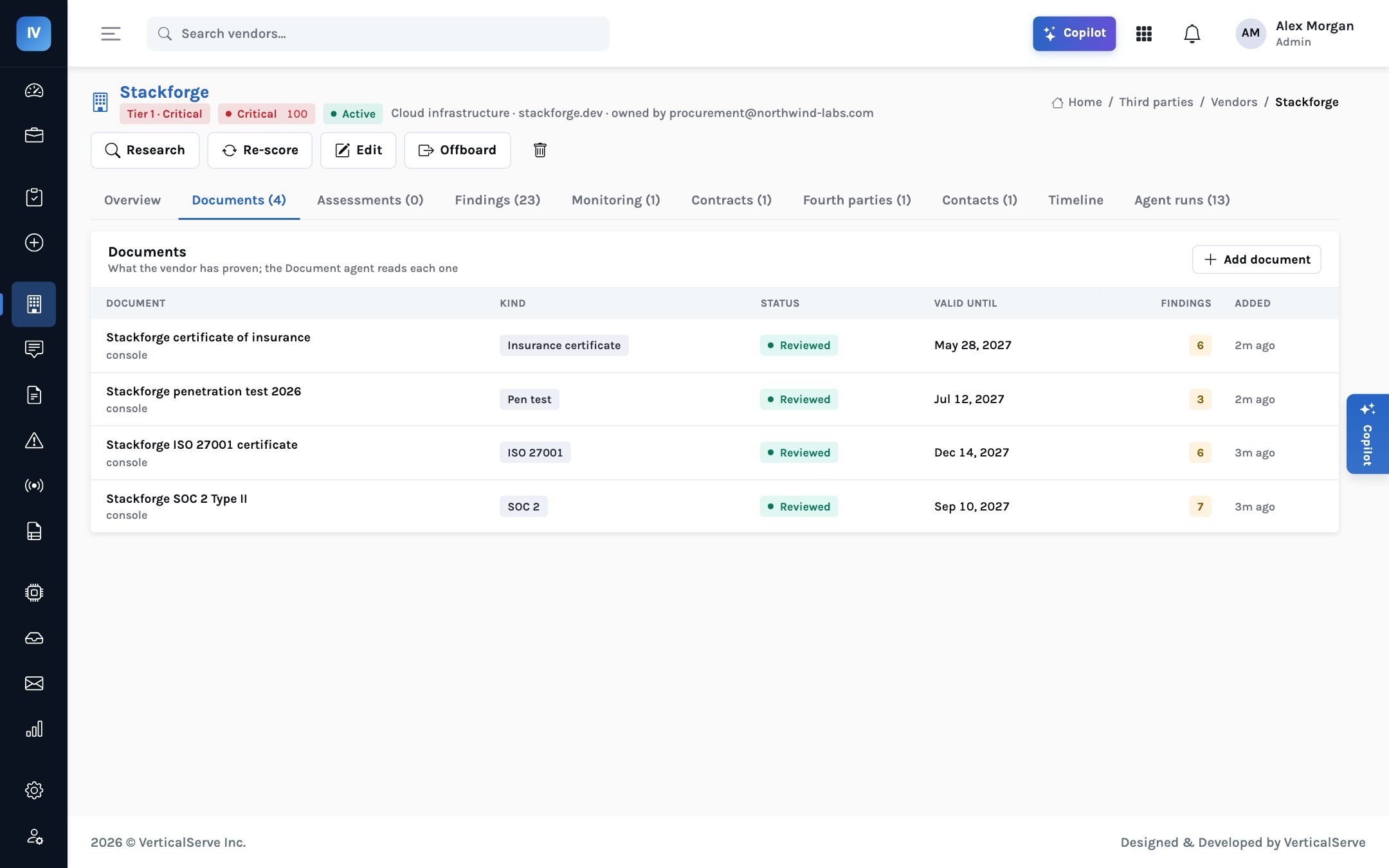
That is a third-party risk in its own right. Whoever hosts the system becomes one of your vendors, with access to all of the above. A sensible programme applies its own tiering to that decision: it is a Tier 1 relationship either way.
The two editions
Both editions are built from the same container images, so the product is the same: the same agents, the same lifecycle, the same vendor portal and outbox. What differs is who runs it, where the data lives, which AI model (if any) the agents use, and a small number of features that depend on a shared service.
| SaaS (default) | Self-hosted | |
|---|---|---|
| Who runs it | VerticalServe: upgrades, availability, backups | Your team, with Docker Compose on your infrastructure |
| Database | Managed PostgreSQL; tenants isolated by row-level security | Your PostgreSQL, used only by you |
| Where documents live | In our hosted environment | In your environment |
| AI model | Provided with the service | The model of your choice, or none |
| Agents without a model | Available; every agent has a rule path | Fully supported; every agent has a rule path |
| Upgrades | Continuous, done for you | When you pull new images |
| Vendor network (planned for 1.3) | Will be available | Not available: it needs a shared service |
| Vendor portal and email approvals | Work out of the box | You expose the portal to vendors and provide outbound email |
The AI question: your model, or none
For many risk teams the real concern is not the database but the model. Sending a vendor's SOC 2 report or a contract to a third-party AI service is a disclosure, possibly one the vendor's NDA does not allow. Self-hosted InsightVendors lets you point the agents at a model you already approve, including one running inside your own environment, or at no model at all.
No model at all is a real option, not a degraded demo. Every agent in InsightVendors has a rule-based path: pattern extraction for documents, rules for routing and tiering, deterministic arithmetic for risk scores, and templates for messages. The model makes the output better — better summaries, better handling of unusual document layouts, better-written redline proposals — but it never makes it work. Each agent run is badged “Rules” or “Model”, so reviewers always know which path produced what they are reading.
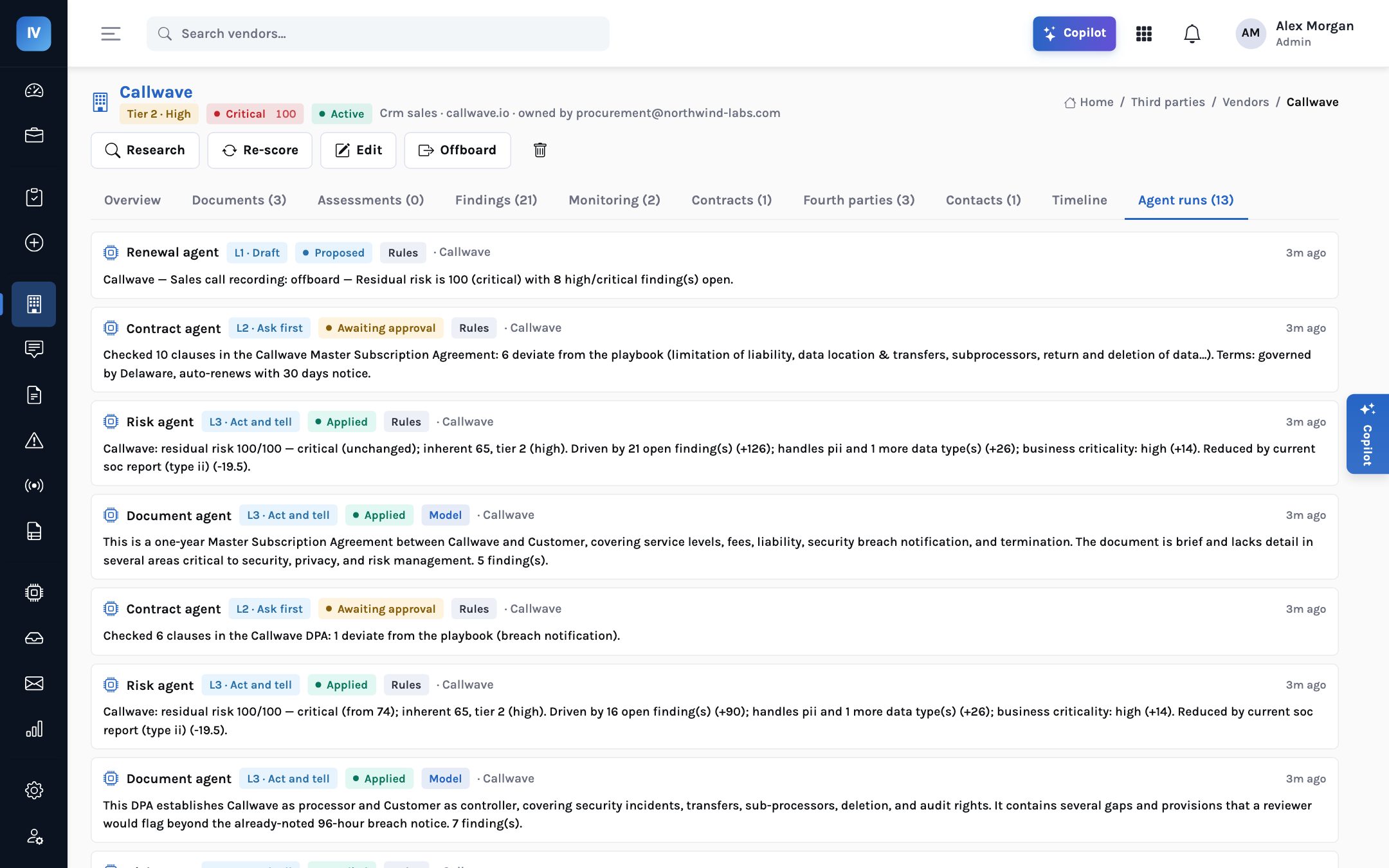
Two rails apply in both editions. Grounding: if a number in a model's answer is not in the source facts, the answer is thrown away. And the risk score itself is always deterministic arithmetic with weights the customer owns; a model can explain the score, but never invents it.
Fields and findings are extracted by patterns from standard documents, with page citations. Routing, tiering and scores come from rules and arithmetic. Messages come from templates. Unusual documents need more human reading.
The same, plus better extraction from unusual layouts, clearer explanations, more natural vendor follow-ups and sharper contract redline wording. The model's numbers are checked against the source facts.
The vendor network, and why it is SaaS-only
The largest single difference between the editions is not available in either yet. The vendor network, planned for release 1.3, lets a vendor answer an assessment once and share it with every customer who asks, instead of filling in the same questions for each. For buyers it means faster answers; for vendors, far less repeated work.
A network needs a shared place where vendors' answers live and from which customers can request them. That place is the SaaS service. A self-hosted install is, by design, a closed environment, so it cannot join. If the vendor network matters to your programme — for example, if you review many common SaaS vendors that are likely to be on it — that is a reason to prefer SaaS. If your vendors are mostly specialised suppliers unlikely to be on any network, it matters less. Either way, we would not choose an edition today on the strength of a feature that is still planned.
How to decide
or SaaS with the rules path, if acceptable"] B -- No --> D["Do you have a team to run, patch and back up the service?"] D -- No --> H["SaaS"] D -- Yes --> E["Does the planned vendor network matter to you?"] E -- Yes --> H E -- No --> F["Either works. Choose on cost and operating preference."]
A first pass. Your compliance team's reading of the rules comes first.
In practice, the decision tends to follow the sector. Most technology companies, professional services firms and mid-sized businesses choose SaaS: the operational burden is the vendor's, they get features first, and their auditors are satisfied by the service's own assurance. Banks, insurers, healthcare providers and public bodies more often choose self-hosted because an outsourcing rule, a data-location requirement or an internal policy leaves little choice. Neither is the “serious” option; they answer different constraints.
For the CISO
SaaS adds a Tier 1 vendor holding your vendors' confidential documents; review it as you would any other. Self-hosted removes that vendor but makes you responsible for patching, backups and access control.
Either way, check where the AI model runs and what it sees.
For the vendor-risk lead
SaaS means you spend your time on the programme, not on the platform. Self-hosted means you plan how vendors reach the portal and how approval emails are sent.
Both give the same agents, lanes, outbox and audit trail.
For the board
The choice is a risk decision, not an IT preference. It should follow the organisation's outsourcing policy and regulatory obligations.
Ask which edition the regulator or auditor would expect, and why.
What self-hosted gives up, plainly
Self-hosted does not get the vendor network (planned for 1.3) because it needs the shared SaaS service. Upgrades arrive when you pull them, so you will run behind SaaS unless you upgrade regularly. Some monitoring depends on outside sources: in 1.0, signals come from InsightPulse company intelligence and the API; confirm with us which feeds a self-hosted install can reach in your network, and use the API for any others. And running with no AI model means more human reading of unusual documents. None of these is a reason not to self-host if your rules require it; they are reasons to plan for it.
Review the edition you choose like any Tier 1 vendor
Whichever edition you pick, apply your own programme to it. If you choose SaaS, VerticalServe becomes a Tier 1 vendor holding confidential documents about your other vendors, and it should get the review a Tier 1 vendor gets: its own assurance documents, its subprocessors, its DPA, where the data is held and which AI model sees what. Tenants in the SaaS service are separated by PostgreSQL row-level security, which means every query is filtered to your organisation inside the database itself, not only in the application; ask us how that is tested.
If you choose self-hosted, the review turns inward. Your platform team becomes the operator, and the questions an auditor would ask a hosting provider now land on them: who has administrative access, how backups are taken and tested, how quickly security updates are applied, how the vendor portal is exposed to the internet and protected, and where the AI model, if any, runs.
Outsourcing rules, data-location requirements and the confidentiality terms in vendors' NDAs.
A hosted model, your own model, or none. Every agent works on its rule path if the answer is none.
For self-hosted: patching, backups, monitoring, access control and the upgrade rhythm.
The vendor portal is reached by signed link; in self-hosted you decide how it is exposed and protected.
Approvers can decide by signed, single-use, expiring email link; that needs reliable outbound email.
If many of your vendors are common SaaS providers, the 1.3 vendor network is a point in favour of SaaS.
Moving between editions
Because the editions share the same images and the same PostgreSQL schema, the choice is not permanent. An organisation can start self-hosted while its outsourcing review runs and move to SaaS later, or start on SaaS and bring the system in-house if a new rule requires it. Plan the move as a data migration with a cut-over date, and expect to re-check integrations such as email and the vendor portal address. Talk to us before you commit to either path; pricing is by vendors under management in both editions, and we will quote against your situation.
Where your vendors' secrets live is itself a third-party risk decision. Make it the way you would make any other.
Choose SaaS when nothing forbids it and you want the network and the operations handled; choose self-hosted when a rule or policy requires it, with your own model or none, knowing every agent still works on its rule path.