For most of the last twenty years, a vendor was something you bought, not something you were. A contract drew the line: their systems, their people, their problem. That line has stopped meaning much. Your customer data sits in a dozen software-as-a-service tools. Your payments run through a provider you have never visited. Your support team wants an AI tool that learns from ticket history. When one of those vendors is breached, goes down or quietly changes what it does with your data, your customers, your regulators and your board treat it as your incident, because it is.
This post is about what changed, what it costs, and what a third-party risk management (TPRM) programme now has to do. It is written for anyone who owns part of the answer: the CISO, the head of procurement, legal and privacy counsel, finance and the executive who signs off on all of them. Where it shows the product, it uses the demo organisation in our screenshots, Northwind Labs, and its vendors, all of which are fictional.
In short
- The boundary moved. Data, operations and now AI processing live with vendors. A supplier's incident becomes yours the moment it touches your customers.
- Accountability did not move with it. Regulators, customers and auditors hold the organisation responsible for the vendors it chose and how it watched them.
- The annual questionnaire is not enough. A vendor's risk changes between reviews: certificates expire, breaches happen, terms change, companies are bought.
- A modern programme covers the whole lifecycle. Intake, tiering, evidence-based review, contract terms, continuous monitoring and a renewal decision made before the notice date.
- Agents can do the reading and chasing. People still decide. InsightVendors hands reviewers a prepared decision with page citations and an explained score.
What changed: the boundary moved
Three shifts made third-party risk a first-party problem. None of them is new on its own; together they changed the scale.
The data left the building. A mid-sized company now runs its sales calls, support tickets, payroll, accounts payable, code and production hosting on other people's platforms. Each of those vendors holds some of the organisation's most sensitive data, often with standing access through an integration. The data map is no longer a diagram of your systems; it is a diagram of your contracts.
Operations concentrated. Many organisations depend on a small number of cloud, identity, security and payments providers, and so do their vendors. An outage at one shared provider can take down several of your suppliers at once. That is concentration risk, and it is invisible if you only look at your direct vendors one at a time.
AI vendors arrived. Tools that draft, summarise and answer are easy to buy and easy to like. They also raise a question older software rarely did: does the vendor, or one of its own suppliers, use your data to train a model? In the demo, the terms of service for a fictional AI support tool, Quill AI, contain a clause that lets the vendor train on customer data. The business case for the tool is real. So is the clause.
data
Industry breach studies have put the third-party share of breaches on a clear upward path. Verizon's Data Breach Investigations Report for 2025 reported that breaches involving a third party roughly doubled year on year, to around three in ten. IBM's Cost of a Data Breach Report 2024 put the global average cost of a breach at about US$4.9 million and found that supply-chain and third-party involvement tends to make breaches costlier and slower to contain.
Sources: Verizon Data Breach Investigations Report 2025; IBM Cost of a Data Breach Report 2024. Figures vary by year, sector and region; treat them as direction rather than forecast.
Recent history supplies the examples. The 2023 exploitation of the MOVEit Transfer file-transfer product reached a very large number of organisations, many of which had never heard of the tool because it was used by one of their suppliers. In July 2024 a faulty update to a widely used security product crashed Windows machines across airlines, hospitals and banks in a single morning. Neither was a failure of the affected organisations' own controls. Both were their problem.
Three ways a vendor becomes your incident
It helps to be specific about how vendor risk turns into business harm, because each path needs a different control. The demo vendors illustrate all three.
| Path | What it looks like | Demo example (fictional) | The control that matters |
|---|---|---|---|
| Breach | The vendor's systems or accounts are compromised and your data goes with them | Callwave, a sales call recording vendor, confirms a credential-stuffing incident affecting a small number of accounts | Knowing what data and users the vendor has, and reacting the same day |
| Outage or failure | The vendor stops delivering, or a vendor it depends on does | Stackforge, the production hosting provider, reports a six-hour outage in one region | Tiering by business criticality, fourth-party visibility, exit plans |
| Terms and data use | The contract allows something you would not have agreed to if you had read it | Quill AI's terms let it use customer data to train models and set no deletion obligation on termination | Contract review against a playbook before signature, not after |
| Evidence going stale | The assurance you relied on quietly lapses | Ledgerly's SOC 1 Type II report expired in September 2026 | Document validity tracked, with a signal and a finding on expiry |
The fourth row is the least dramatic and the most common. A SOC 2 report (an independent auditor's report on a service organisation's controls) covers a fixed period. An insurance certificate has an expiry date. A penetration test is a snapshot. Programmes that review a vendor once and file the evidence end up relying, a year later, on documents that no longer say anything about today.
Accountability did not move with the data
Outsourcing a service does not outsource responsibility for it. That principle runs through almost every framework that touches vendors. In the EU, the Digital Operational Resilience Act (DORA), applying from 17 January 2025, makes financial entities manage ICT third-party risk and keep a register of information about their ICT providers. In the US, the federal banking agencies' interagency guidance on third-party relationships from June 2023 expects risk management across the whole lifecycle. GDPR Article 28 makes a controller responsible for choosing processors that give sufficient guarantees. Outside regulated sectors, SOC 2 and ISO/IEC 27001 audits ask how vendors are assessed and monitored. We read these side by side in a separate post on what regulators expect; the short version is that every one of them expects you to know your vendors, size your effort to the risk and keep records that prove it.
Customers ask the same questions, in the form of security questionnaires and contract clauses about subprocessors. The board asks them too, usually after an incident at someone else's company makes the news. The same fact reads differently to each of them.
For the CISO
A vendor breach is a security incident with a reporting clock, and your logs may not see it. You need to know within hours which vendors hold which data and which have access to your systems.
The questions are which critical vendors have current evidence, which have open critical findings, and which react automatically when a signal arrives.
For the vendor-risk lead
Every request is a queue item competing with every other request. The job is to size effort to risk, so a design retainer does not get the review a hosting provider needs.
The questions are where requests wait, which documents are expiring and which renewals have a notice date inside ninety days.
For the board
Third-party risk is now an operational and regulatory risk, not a procurement detail. The board needs a short, honest picture: how many critical vendors, how concentrated, how current the evidence, and what changed this quarter.
The question is whether the organisation can show it chose and watched its vendors with care.
Why the traditional programme struggles
Most TPRM programmes were built around a questionnaire. A vendor is sent a few hundred questions, answers some of them, attaches a SOC 2 report, and a reviewer reads both. The result is filed and revisited a year or more later. That design has three weaknesses that the shifts above expose.
First, it is slow. The business waits weeks for an approval, so it routes around the process: teams buy on a credit card, or sign the vendor's standard terms because the review would take longer than the pilot. Second, it is shallow where it matters. A reviewer with forty open requests cannot read every SOC 2 report end to end, and the important facts — the audit period, the exceptions, the controls the customer must operate itself — are buried on page sixty. Third, it is static. A breach, an acquisition or an expired certificate between reviews goes unnoticed until the next cycle, if the next cycle happens.
Every vendor gets the same long questionnaire. Documents are attached and skimmed. Approvals happen one after another by email. The record is a spreadsheet. Renewals arrive when the invoice does.
The tier decides how hard to look. Documents already on file answer what they can, with page citations. Reviews run in parallel lanes with owners and deadlines. Signals keep the record current. Renewals are recommended before the notice date.
What a modern programme has to do
A programme fit for this risk covers the whole vendor lifecycle, not just the first review. The stages are familiar; the difference is that each has to produce a record and hand off to the next without someone carrying it by hand.
one sentence"] --> B["Intake
duplicates, questions"] B --> C["Triage
tier and inherent risk"] C --> D["Reviews in parallel
security, privacy, legal, finance, IT, owner"] D --> E["Decision
approve, conditions, reject"] E --> F["Contract and onboard"] F --> G["Monitor
signals, expiring evidence"] G --> H{"Renewal"} H -- "Renew or renegotiate" --> G H -- "Offboard" --> I["Access revoked, data returned or deleted"] G -. "Breach or major signal" .-> C
The vendor lifecycle. Every stage writes to the activity trail; a serious signal sends the vendor back to triage.
Four principles make that lifecycle work in practice.
- Size the effort to the risk. Tier vendors from what they touch: data sensitivity, system access, business criticality, spend and regulatory flags. A Tier 4 design retainer and a Tier 1 hosting provider should not get the same review.
- Start from evidence, not from questions. If a current SOC 2 Type II report already answers a question, do not ask the vendor again. Ask only what the documents leave open, and record where each answer came from.
- Make the score explainable. Separate inherent risk (before controls, from what the vendor touches) from residual risk (after the evidence). Show every factor and its points, so a reviewer can argue with it.
- Keep watching. Breaches, sanctions, adverse media, financial distress, expired documents and silence on the vendor portal are all signals. Each needs a reaction sized to the tier: a note, a finding, a re-assessment or an escalation.
How InsightVendors approaches it
InsightVendors is agentic third-party risk management: a person asks for a tool in one sentence, and agents do the intake, research the vendor, pick the right assessment, read the SOC 2 report and the contract, score the risk, route the approvals, watch the vendor afterwards and come back before renewal with a recommendation. People decide. Agents hand them a prepared decision: findings with page citations, a risk score with its reasons, contract clauses that deviate from the playbook, and a recommendation to sign, change or send back.
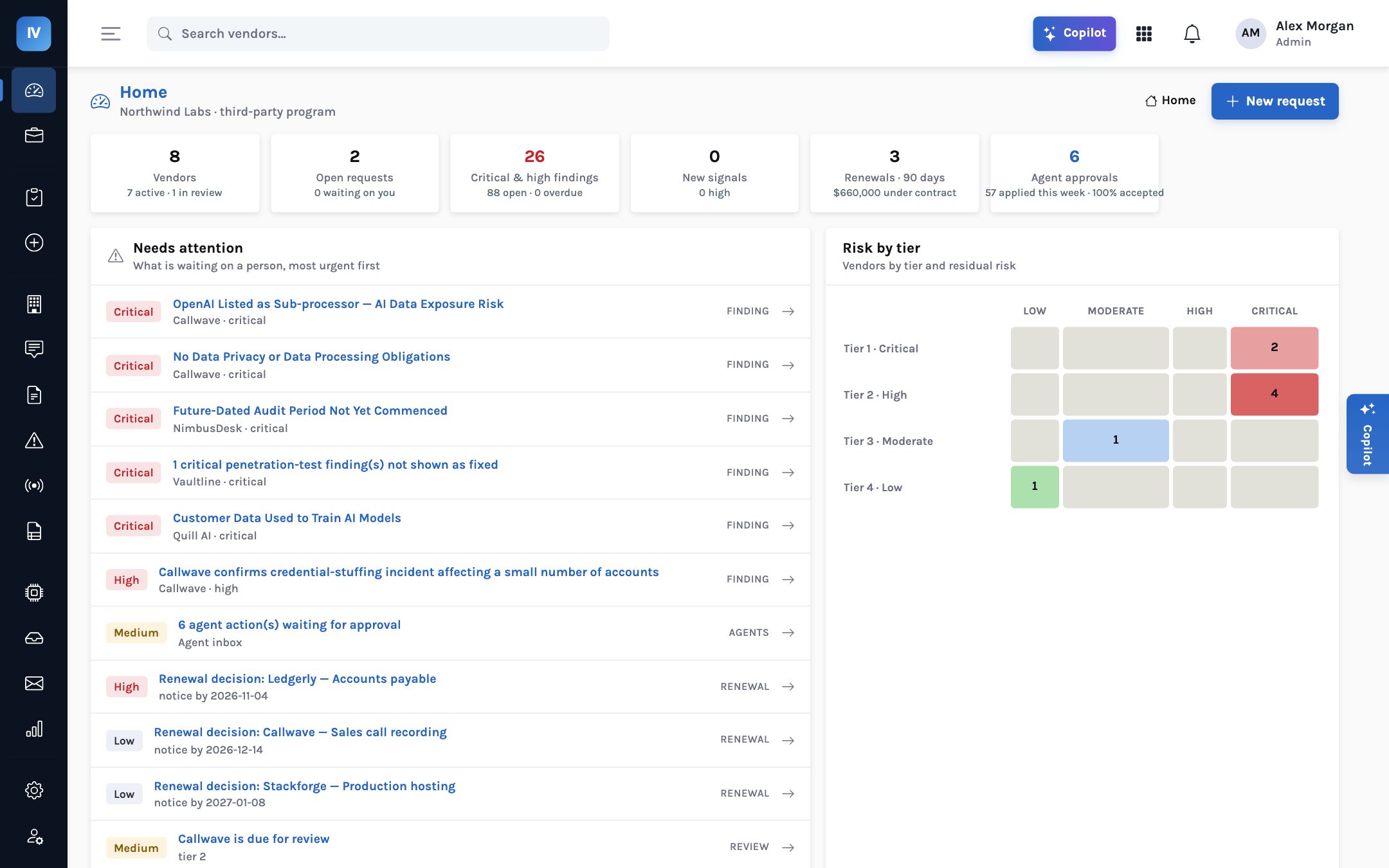
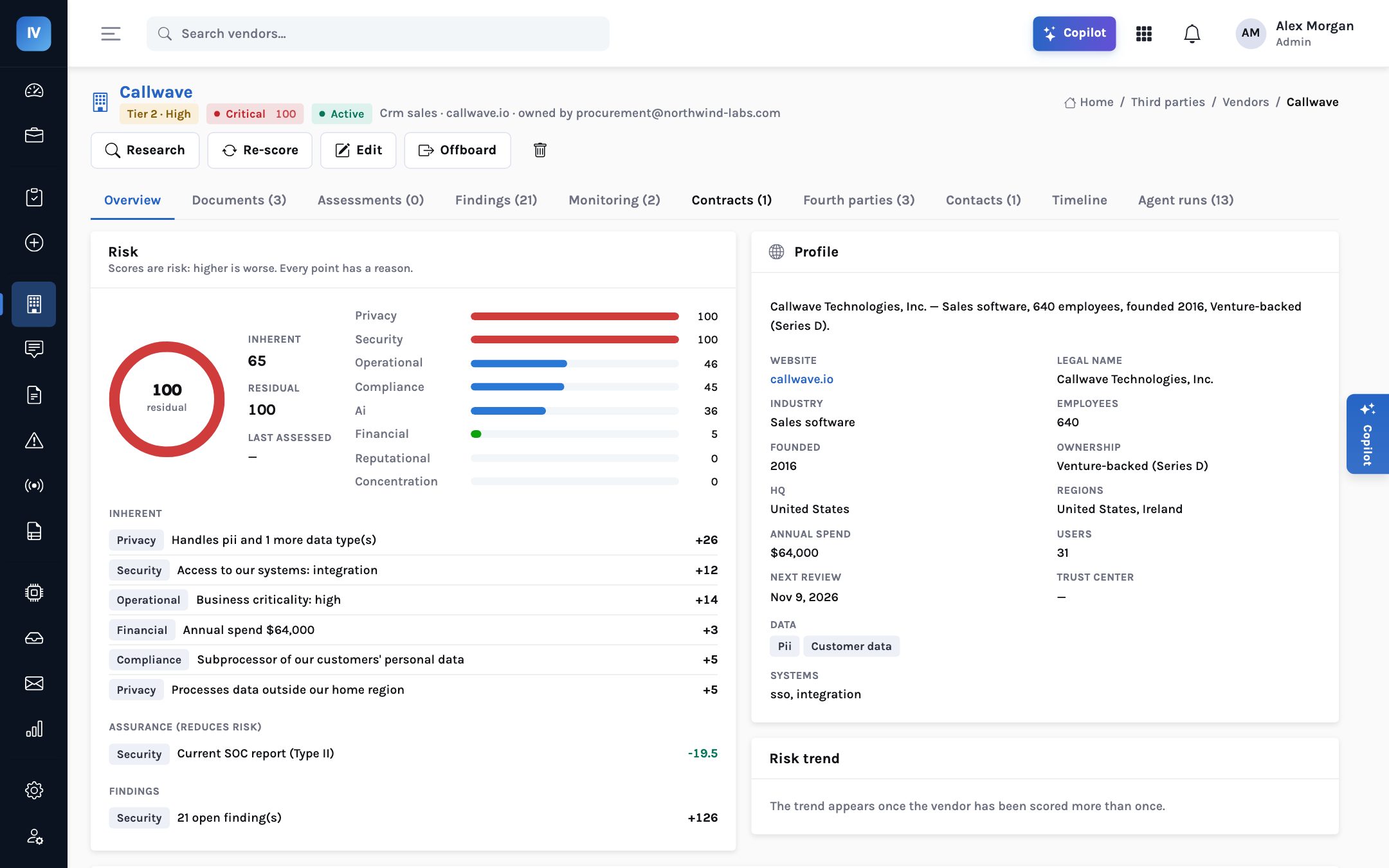
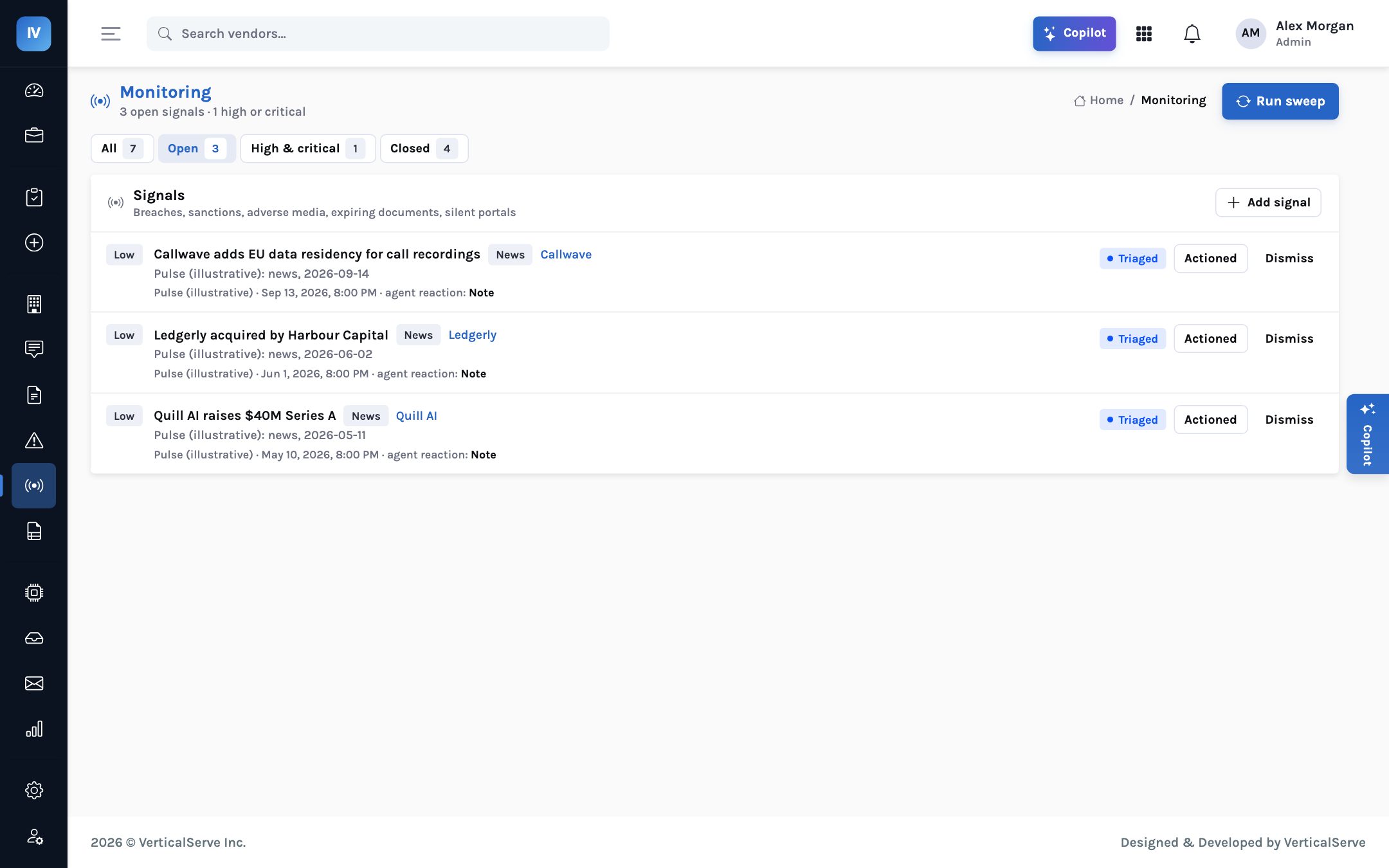
Take the breach path from the table above. In the demo, a signal arrives: Callwave confirms a credential-stuffing incident. Callwave is a Tier 2 vendor that records sales calls for 31 users, under an MSA (master services agreement) and a DPA (data processing agreement) already on file. The Monitoring agent decides the reaction for its tier — here, a re-assessment. The Document agent has already found, in the DPA, that OpenAI is listed as a sub-processor, and in the MSA that there are no data privacy or data processing obligations. When renewal comes round, the Renewal agent, working at L1 (it drafts, a person decides), proposes offboarding because residual risk is 100 with eight high or critical findings open.
None of that requires the agent to be trusted blindly. Every agent action is an agent run with its input, output, autonomy level, what it cited and who approved it. Every message an agent writes to a vendor waits in an outbox until a person releases it. And every agent has a rule-based path that works without an AI model; the model makes the output better, it does not make it work.
What this does not do
No tool removes third-party risk. InsightVendors can make sure you know which vendors hold what, read the evidence properly, and notice when something changes; it cannot make a vendor secure. Monitoring is only as good as its feeds: in 1.0 signals come from InsightPulse company intelligence and from the API, and breach feeds and security-ratings connectors are planned, not supported. The demo data, including every vendor named in this post, is fictional.
Where to start
You do not need to rebuild the programme to make progress. The order that tends to pay off first is: know what you have, size it, and make sure nothing important is expiring or renewing without a decision.
Know what you have
- One list of vendors, with an owner, the data each touches and the contract end date
- Tiering rules agreed between security, privacy, legal and procurement
- Current SOC reports, certificates and insurance documents gathered in one place
Size and read
- Tier 1 and Tier 2 vendors scored, with inherent and residual risk explained
- Expired or expiring evidence turned into findings with owners
- New requests routed through lanes with service levels
Keep it current
- Monitoring on for every vendor, with reactions by tier
- Every renewal inside ninety days carrying a recommendation
- A short quarterly report for the board on critical vendors and open findings
The rest of this series goes deeper: a map of the tools on the market and what each is good at, why vendor reviews take weeks, what regulators expect, and how tiering and scoring work. If you want to see the lifecycle on your own vendor list, the demo walks through every stage shown here.
Your vendors' incidents are your incidents. The programme has to know them as well as it knows its own systems.
Know what each vendor touches, read the evidence instead of filing it, keep watching after the contract is signed, and decide on the renewal before the notice date decides for you.